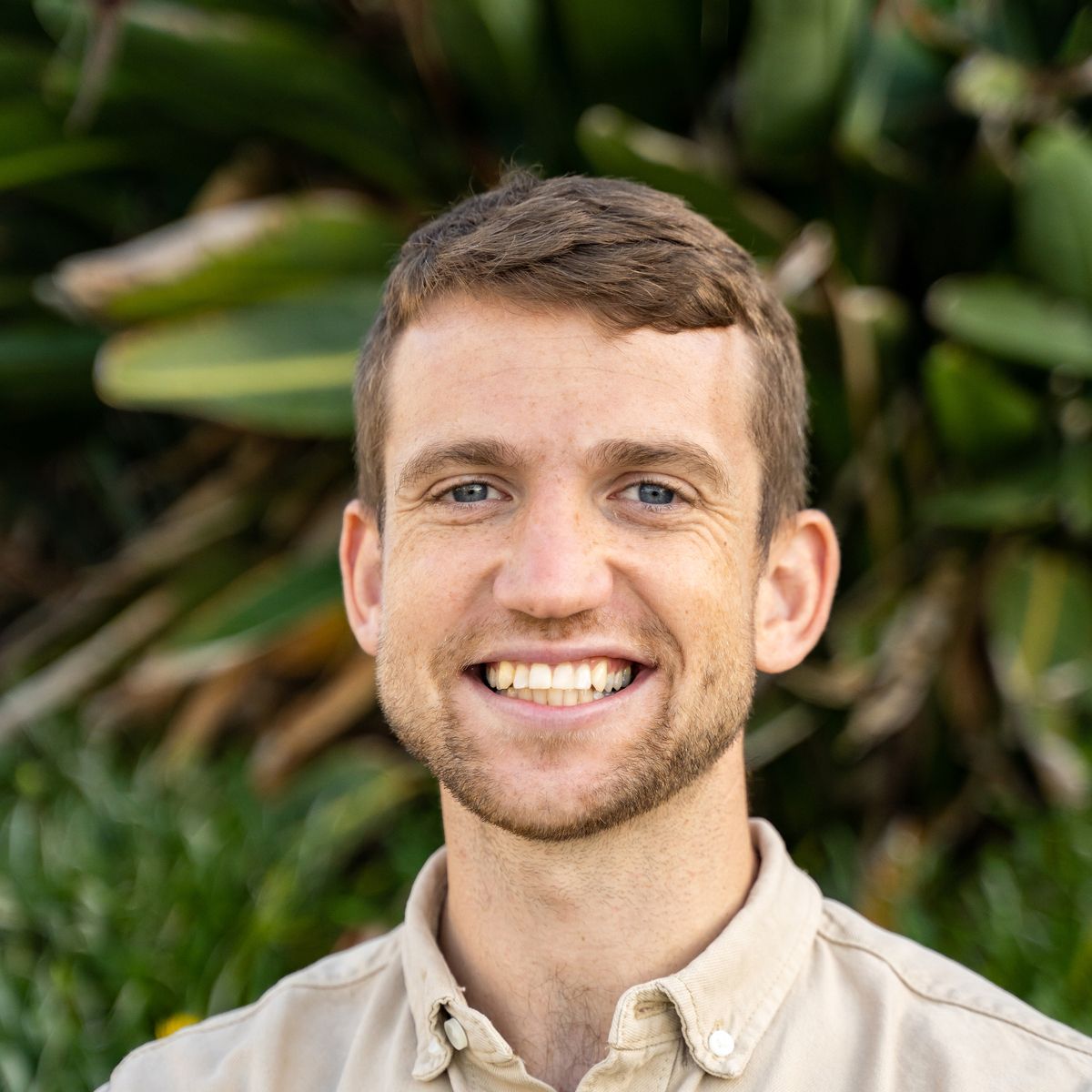
Most Irish engineers who emigrated during the GFC found work in construction abroad and stayed there.
Ken King did not. Instead, he embarked on an entrepreneurial journey that Forbes Australia recently covered, which ranked among Forbes's 10 most-read stories in 2025, detailing how Ken solved the drone industry’s ‘holy grail’.
From Celbridge, County Kildare, Ken moved to Melbourne in 2009 to continue working in building services engineering. Within a few years, he was fascinated by an entirely different kind of machine.
By 2016, he had a drone operator's licence. By 2019, he had co-founded Freespace Operations. By 2025, he and co-founder Dr Leonard Hall had cracked a major industry pain point in drone technology: cooperative lift, in which multiple autonomous aircraft share a heavy payload in flight.
Freespace started as a garage operation in Adelaide six years ago. Today, it is bootstrapped, profitable, approaching 20 employees, and completing a new factory in Melbourne. The company has delivered over A$9 million in Australian Government and Defence contracts alongside commercial projects across four continents. No investors. No hype cycle. Just methodical engineering and an Irish stubbornness that seems purpose-built for the job.
P.s be sure to check out a great video of Ken at the end, where he talks about how his irish roots has influenced his entrepenurial journey
⚡Ken King - Quick Facts ⚡

☘️ From: Celbridge, Co. Kildare | 📍 Based: Melbourne, Australia |
🔗 LinkedIn: Ken King | 🏢 Company: Freespace Operations |
🎓 Background: BEng Building Services Engineering, DIT Bolton Street (now TUD). 15+ years in construction across Ireland and Australia | 🤝 Co-Founder: Dr Leonard Hall (CTO), one of the world's leading drone flight-control developers |
💰 Funding: Entirely bootstrapped and profitable. ~$100K AUD each from personal savings | 🏗️ Flagship Product: Callisto 50, a modular industrial multirotor with 52 kg max takeoff weight and 26 kg payload capacity. |
🌍 Markets: Australia, USA, Canada, Europe, India | 🏆 Recognition: Forbes Australia feature, NASA Space Apps Challenge winner, 29 Australian Government and Defence contracts |
🔧 From Bolton Street to Flying Robots
You're an Irish building services engineer who now runs a drone company in Melbourne. How does that happen?
I always wanted to be in aerospace. I used to write letters to NASA when I was nine years old, and they actually wrote back, which was pretty nice as a kid. But I just didn't see the pathway in Ireland. We had a small aerospace industry doing maintenance, and I knew if I went that route, I'd have to leave anyway.
I chose building services engineering because I thought energy would be a big focus in the future. Did seven years in Ireland, then came out to Australia as a GFC refugee in 2009. Pretty typical Irish construction story.
I saw drones for the first time in 2012 and studied them for about a year on YouTube, in chat rooms, and wherever I could find information. There were no guides. You had to figure it all out yourself. I built my first one in 2014, and it worked. By 2016, I got my licences with CASA and set up a small company called Eirobotix. I gave up construction completely in 2018.
🚁 The Holy Grail: Cooperative Lift
Forbes described what you're doing as the "holy grail" of drone technology. What does that actually mean?
Our existing product is the Callisto 50, which has been around since 2019. We've kept quiet about it and let the engineering do the talking. It's the absolute bedrock of the Cooperative-Lift technology.
What we do is take an existing, proven aircraft and effectively scale it up. Think Transformers, where the robots join together to create a bigger one. We take two or four Callisto 50s, run a slung line between them to a nodal attachment point, and both drones work in unison to double the output. Check it out:
The reason this matters is that drones don't scale linearly. A small drone is relatively easy to make, fly, and keep safe. A big one is almost exponentially harder. If you were to make a Callisto 100, it would be five to ten times harder, cost far more, and the market would be a fraction of the size. Cooperative lift leverages existing technology to get more from what you already have.
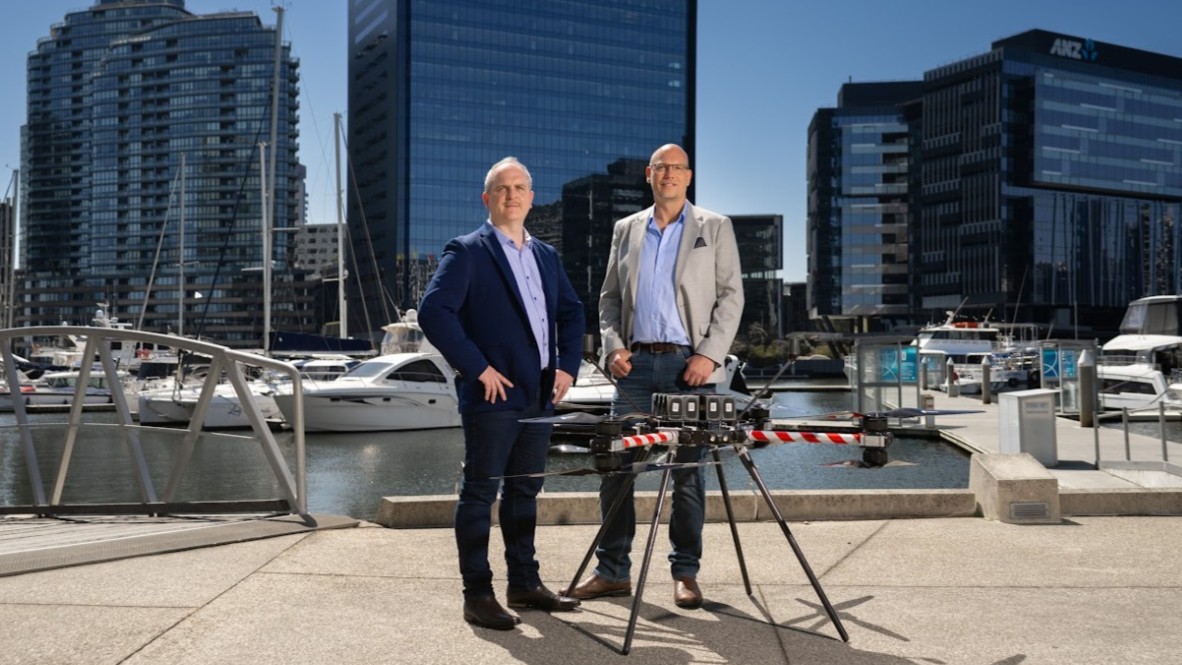
And your co-founder, Leonard Hall is a major part of making this work?
Leonard is an extremely capable engineer. He's one of the smartest men I've ever met. He has a DaVinci-esque mindset where he can imagine something, create it, and then iterate from it. He wrote much of the control software used in autopilots worldwide. Before COVID, pretty much every industrial multirotor around the world was tuned by him.
We met at the Avalon Air Show in 2017. We liked how each other operated. Our skills crossed over and were complementary. I offered to set up the business, run it, and do all the business development and drone operations licensing. He would concentrate on core engineering. He's the CTO; I'm the CEO. We also have Richard Hall as our COO.

Leonard and Ken pictured
💰 Bootstrapped, Profitable, No Investors
How did you fund this without investors?
I was able to do this because I had a well-paying construction job. That's one of the good things about construction: it pays well, and because you work like a mule, you don't have a lot of opportunity to spend it. I had about $100,000 to put in. Leonard would have been similar.
I was also single at the time with no kids, so I could commit 100%. And I mean 100%. Working 80 hours a week.
We're entirely self-started, bootstrapped, and profitable. We have no investors. We own everything. We've got money in the bank and a pathway forward. I don't think we need anything unless something major happens. We've gone this far with a formula that works

🌍 Winning International Contracts
You've won multi-million dollar contracts globally. How does a bootstrapped Melbourne company earn the trust of major clients far from home?
A fair amount of obstinance. But really, when you build something great, and you know it's great, you don't need a big advertising strategy. You build it and they will come.
The Callisto 50 can pick 25 kilograms off the ground like a strongman. It can carry it up to 5,000 or 10,000 feet. How can that not be useful?
We were involved in some defence projects from the start, proof of concept stuff. The feedback was: "we can't get this anywhere else." Customers were happy to advertise it through their own success. Word got out and it just built organically.
Who's using it, and what for?
We've made over a hundred of them. The biggest commercial use is power line stringing. An Australian company called Infravision uses them in Australia, the US, Canada, and India.
They pull a draw wire from pylon to pylon using the drone, threading a Dyneema sailing line through. Once threaded, you use that to pull a larger conductor wire through on a hydraulic pulley.
Infravision's president of aviation confirmed they evaluated heavy-lift drone platforms worldwide, and the Callisto 50 was the first to deliver the reliability and performance they needed at scale. Those guys absolutely trashed the aircraft, day after day, working in the Californian bushfires, the Californian floods, and heavy storms in Washington state. The aircraft powered through all of it.
🔮 The Drone Industry's iPhone Moment
Where is all this heading?
My father worked for Telecom Eireann and Eircom all his life. He was involved in the emergence of the mobile phone industry. I was 12 or 13 years old calling people in England on a mobile phone for free because he was testing the networks. I saw those big bricks turn into small handsets, then the iPhone, and now what we have.
Drones leverage a lot of mobile phone technology: sensors, IMUs, position sensors, and connectivity. The drone industry is really a coalescence of mobile phone tech, laptop battery tech, and motor technology from industrial robotics. That's how it became so affordable and accessible.
I don't think we've had the iPhone moment in drones yet. We're getting close. There will be a time where we remember we didn't see drones in the sky. They'll become intrinsic in our lives, the way you can't imagine not having a mobile phone now.
And it's not just flying drones. You'll see land, air, and sea drones teaming up, using their unique advantages to become more than the sum of their parts.
💡 Leadership Lessons
Q: Where is all this heading?
Be brutally honest. With yourself and with your customers. I've seen this time and again in our industry. Customers get led down the garden path with claims that never materialise. Everyone's time and money gets wasted, and the whole industry gets a bad rap. Understand what you don't know and be honest about it.
Pick niches that matter. Pick difficult challenges and stick with them. Don't spread yourself too thin. Early on, I was building helicopters, multirotors, fixed wings, VTOL drones, the whole gambit. But you end up a jack of all trades, master of none.
Build the ecosystem, not just the product. It's like when Tesla brought electric cars to market. Great, here's a Model S. How do you charge it? How do you maintain it? How do you insure it? Tesla had to build charging networks and support stations. You're not just building a drone. You need an entire ecosystem to access and support it.
Don't quit. It will be difficult, straight up. You need support from your family and from your own inner reserves, because the phone will ring at all hours when you're running an international business. If you don't nurture it, it'll die.
Spread your knowledge. We started taking on employees about two and a half years ago. That was very daunting, but it's one of the best decisions we've made. I get a great kick out of teaching what I've learned. Bring people along with you, especially the young.
☘️ The Irish Bit
How have your Irish roots influenced your approach as an entrepreneur?
When I came to Australia, I settled in with the Irish, then moved away from it and tried to be Australian. After a few years, I realised: no, I'm Irish. I am what I am.
It's a bit of a paradox because you don't take yourself too seriously in Ireland, but this is a very serious business, building flying robots. That dichotomy actually helps. You're approachable, you can get on with people, but you're resolute when you need to be.
The Irish aren't afraid of conflict. We can have an argument and stand up for ourselves. You need to do that in this industry and in lots of others. We have a reputation for it, in a good way.
And remember to have a laugh as well. Life's for living.
Know a founder who deserves to be featured? Reply to this email. 🤝
Was this forwarded to you? Subscribe to Irish Insights and join the community.